Showing posts with label commercial photography. Show all posts

Monday, June 6, 2011

The German American Collection, The Wedding Picture


Again, I bought the butt end of an estate collection. A dealer had sold a number of photos individually, and then put everything else on-line in a couple of lots. This was the one I was able to get. Because it's all such a mish-mash, I'm putting things up when I get around to it with no real time table. Basically, when it gets done, it gets done. This photo, and what's left of an old photo album which is a long way from being posted, is why I'm calling it the German American collection. Stamped on the back, "Photohaus Karl Borft, Hieben, Bahnhofftr. 63" Well, my German is pretty bad and some of the letters were in the old style, Gothic script, which I often find confusing, but here goes. Photohaus is pretty obvious, so let's say Karl Borft's photo studio. I know that banhof is a station, so I'm guessing that the added tr. makes it a train station. I am confused about hieben though. I ran it through Google translate and got "cut down" and that makes no sense to me whatsoever. I hope this couple got out of Germany before the 1930's. Click on German American in the labels section to get the other parts that are available for viewing.

Friday, May 20, 2011

The German Couple


I almost didn't put up this nice studio portrait because of the prints textured surface. I had to use the descreen setting on the scanner, losing some of the sharpness. So, why is that I have so many pictures from Germany? Is it just a coincidence, or did German immigrants to the United States treasure their photographs more than immigrants from other countries? A question that will never be answered. Stamped on the back, "Foto Dickopf, das Fachgeschaft in Siegburg." I think that means Photos by Dickopf, at the department store in Siegburg. Any German speakers out there, please feel free to correct my translation.

Wednesday, February 9, 2011

Old California 1


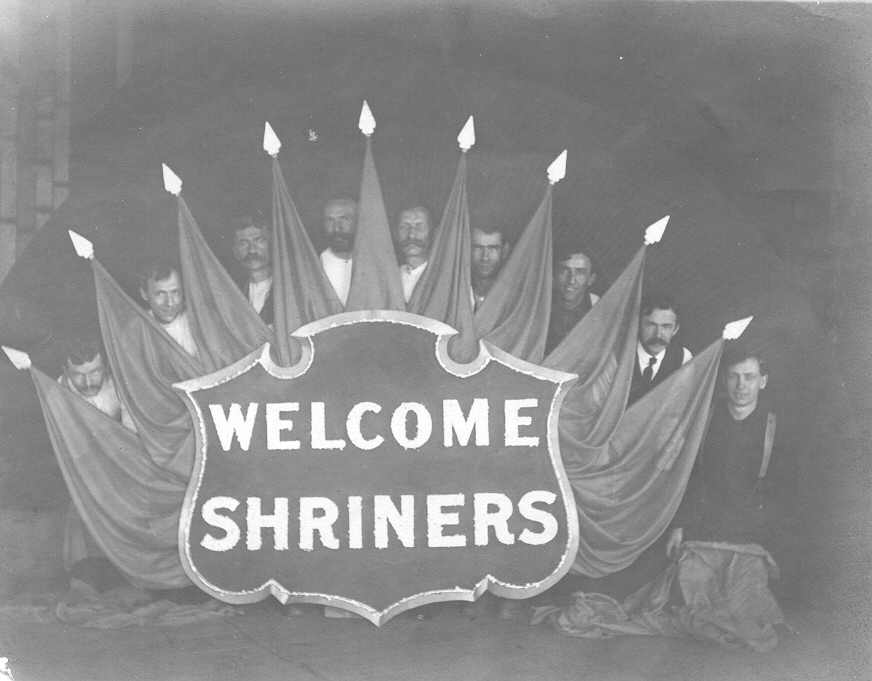
I picked up this small collection of California snapshots from an on-line estate sale. There are 33 images in the group, which I will be posting as three setts of 11. The photographer's life seems to have been centered around the bay area, both San Francisco and Oakland, and the Los Angeles area, for the first ten years or so of the twentieth century. The photo of the tower is easily recognizable as the ferry building in downtown San Francisco. It's still there and still in use. The Lyric Theater sign isn't much use in identifying a location. Lyric Theater was just too common a name for early music halls and Vaudeville theaters. The mansion on the hill photo is labeled, "Home on hill above Ocean at Santa Monica." For those who don't know California, Santa Monica is right next to Los Angeles. The house looks familiar to me, and the next time I'm in Santa Monica, I'll see if I can find it. Pacific palisades, I would think. The football statue from the Berkley Campus is printed on postcard stock, and while it could be a commercially produced card, the lack of patent and copyright info on the back makes me think it might have been printed in a home darkroom. The baby carriage photo is labeled, "Betty at 241 E-31 ST, Los Angeles." The ostrich pictures could have been shot at any of the farms in California that raised exotics for meat, and hides, but it looks like the sight of the commercial ostrich farm in South Pasadena. There is an apartment building on the sight now. The two children photo has a difficult to make out embossing, but under a magnifying glass it looks like, "Mushet Los Angeles." The two Asian gentlemen image has Chinese letters down the left margin, and in English, "Heap Good." And my favorite from this group; the Shriner's photo. California has always been a state that puts a value on boosterism. It's our real estate based economy, I think.

Thursday, December 2, 2010

Another CDV From C. C. Shadle


Most of the carte de visites I own were purchased when I first started collecting photographs and most are from my home state of Pennsylvania. C.C. Shadle was born in 1817 and learned photography at the age of 45, around 1862. After working as an engineer for three years, he opened a photography studio in Apollo, Pennsylvania, (My home town.) around about 1865, the year that the Civil War ended. He then set up a studio in Tarentum, PA, and then moved to Kittanning, (The town where I was born.) in 1869. For more detailed information on the life of C. C. Shadle go to www.freepages.geneology.rootsweb.ancestry.com/~treasures/pa/.../ccshadle.pdf Written on the back, "Nancy's Grand Pa." Stamped on the back, "C. C. SHADLE, Photographer, TARENTUM, Penna."

Monday, October 11, 2010

A Masonic CDV


I haven't suddenly gone crazy for the carte de visite. It's just that, in sorting through some old boxes, I found a cache of them and almost all of them are from my early days of collecting from when I was living in Pennsylvania, and when I first started collecting I put too much emphasis on age. I liked this one because of the Masonic symbols on the back of the card.

Wednesday, October 6, 2010

Middle Aged Woman With Brooch


I'm not even going to take a guess on when these two pictures were taken other than to say that they're probably not too old. This lady has the all most generic look of middle aged woman transitioning into an early old age. Also, the look of an official portrait, a teacher, local council member, or church lady. Say aged 50 to 60. A bit of a snarl in the first picture.

Tuesday, October 5, 2010

A Third Creighton?


In the last two posts, I've put up CDVs of Kate Creighton, who I think is the mother of Louise Creighton, featured in the second of the two Creighton collections. Is this a third Creighton? This portrait is labeled "Kate Creighton" but the hair is straight and a different color. I thought it might have been mislabeled, but the chin shape differs from Louise and is much closer to Kate. There is a third possibility. While it is far more common for sons to named after fathers, it's not unheard of to name a daughter for a mother. The one thing that I'm curious about is that this young lady has pierced ears. Nothing decorative about the photographers stamp on this one, so I didn't bother to scan it in. "JOHN P. ORR. Photographer, 4 doors East of Lowery House, Jefferson Street, BUTLER, PA"

Sunday, October 3, 2010

Kate Creighton, the Mother


I have five images of the Creighton family, this one of the mother and three more of the daughter which will be posted within the next couple of days, and a wild card mystery image. This carte de visite was taken by a photographer in Philadelphia. The child, taken at three different ages was taken by three different photographers in three different communities in western Pennsylvania.

Saturday, October 2, 2010

Carte de Visite, CDV With Hat


This CDV was rather crudely made. I used the scanner to square up the image, but the actual picture, an albumen print, was trimmed out with a very ragged edge, and then pasted, off center, on the card. Unlike the Daguerreotype and ambrotype, carte de visites were cheap to produce, and made it possible for lower income people to have their picture taken and for a young man on the make to get into a non labor profession for a small up front investment. The high collar makes the subject look very statue like, at least to me.

Wednesday, September 22, 2010

The Rose Parade, January 1, 1926 Part 5


The fifth and final part, and the only one with a picture of the big game. Known as the "game that changed the south" that ushered in the "age of Dixie." Underdog Alabama, 9-0, was the second choice to face the mighty Washington Huskies. Led by star running back, George Wilson, the Huskies ran up 300 yards of total offence when he was on the field. After he left the game with an injury, Washington was limited to 17 yards of offence. Trailing 12-0, Alabama half back, Johnny Mack Brown led Alabama to 20 points in the third quarter. Final score, Alabama 20, Huskies 19. The Crimson Tide was awarded it's first national championship. It was also the first Rose Bowl to be broadcast on radio. While he was in southern California, Johnny Mack Brown signed a contract with MGM. He would appear in "Our Dancing Daughters" the movie that made Joan Crawford a star, and "A Woman of Affairs" with Greta Garbo. Sound was not good to Brown, and he ended up as the star of a series of B westerns.

Sunday, September 19, 2010

The Rose Parade, January 1, 1926 Part 4


This is part 4 of 5. This grouping has my second date clue. The photograph with the marching band wearing fezzes, there is another movie theater marquee. This time, Old Clothes, with Jackie Coogan, released November 9, 1925. And, on the guys in the fezzes...are they Shriners?

Thursday, September 16, 2010

The Rose Parade, January 1, 1926 Part 3


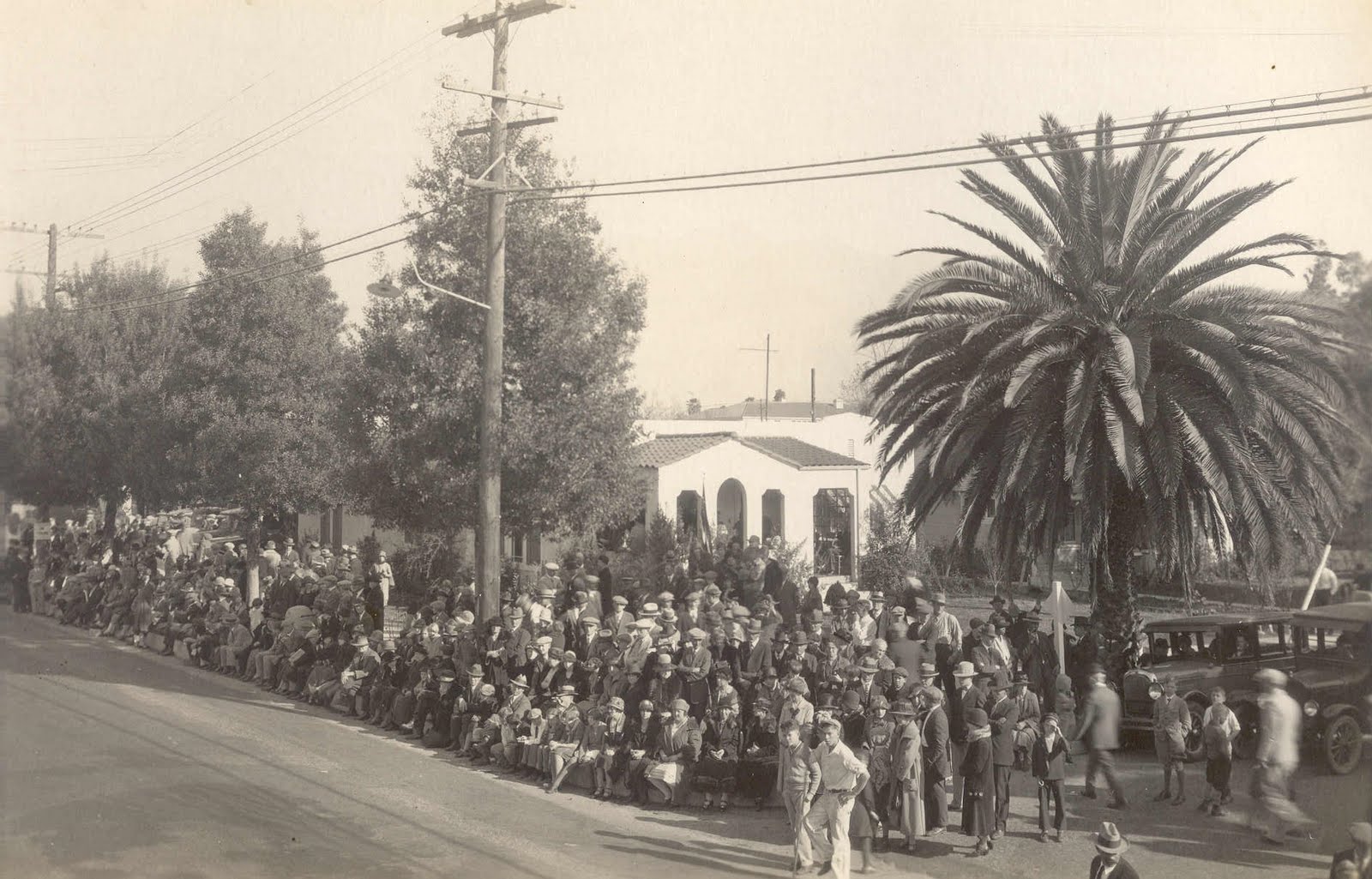
This is part three of five. Just for a bit of variety, I'm going to be putting up some other things for a bit, but check back, because the last two parts should be up by the middle of next week. Stamped on the back of each photo in the set, "NEW PHONE VErmont 4184 AEROGRAPH CO. 1763-5 W. Vernon Ave. LOS ANGELES,-CALIF. No_Price_ Mail Orders Receive Prompt Attention." All of the photos had a punched border, and were bound in a plain card folder. I suspect this might have been a salesman's sample book, marketing to people involved in the parade. Note the Angelus Temple banner. The Angelus Temple was the church founded by sister Aimee Semple McPherson, one of the first major radio evangelists in the United States. She had a national, rather than just a local following.
Tuesday, September 14, 2010

The Rose Parade, January 1, 1926 Part 1


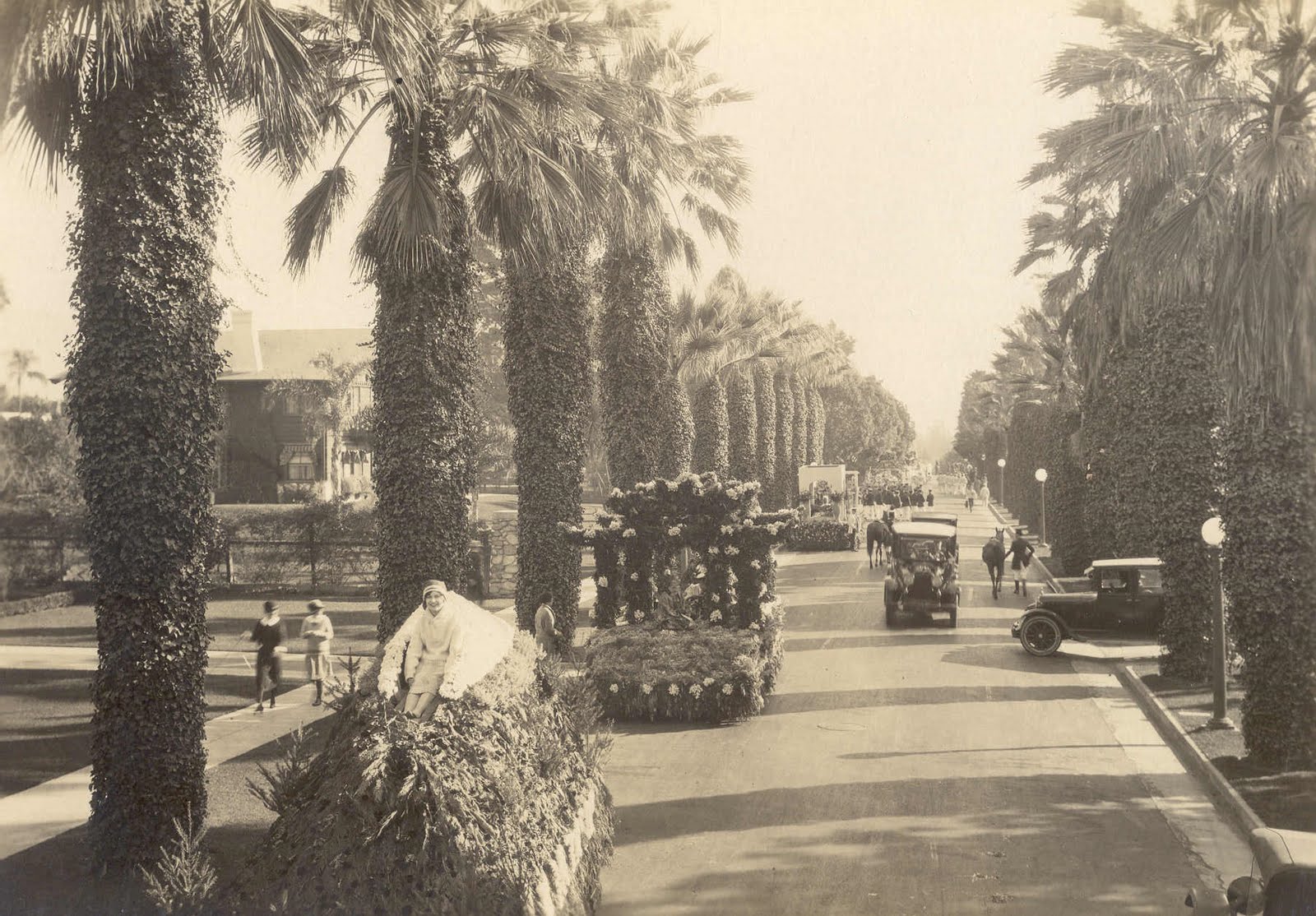
This is the first part of five, showing images from the January 1, 1926 Rose Parade in Pasadena, California. The Rose Parade was first held in 1890. It's original sponsor was Pasadena's Valley Hunt Club. The membership was heavy on cold whether refugees from the east and mid-west, and they wanted to show off their homes and the mild winters of southern California.

Tuesday, August 31, 2010

Correcting New York at War


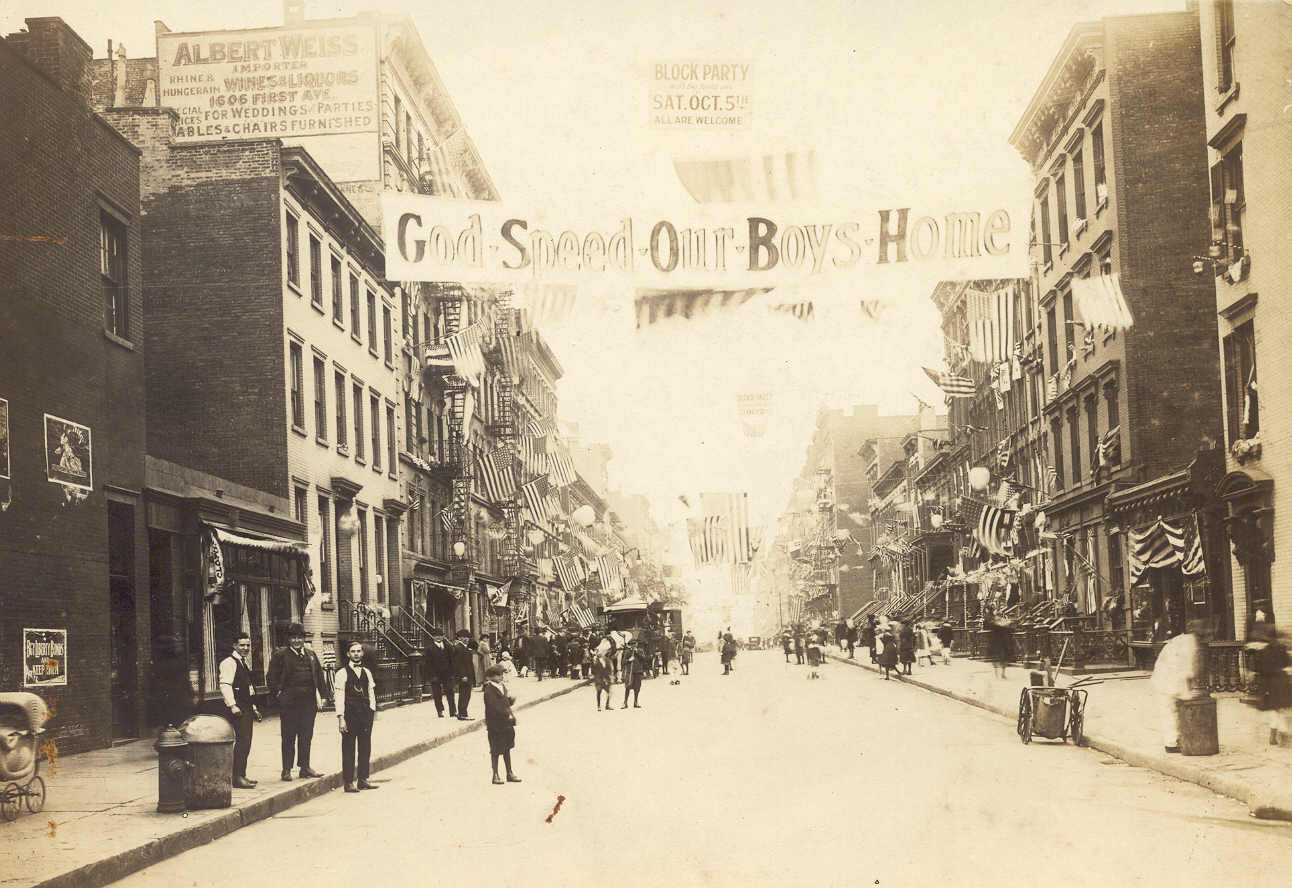
I've had to redo this post. To start with, the two images had become separated, while in storage, and they really needed to go up together. Too, I speculated, that because there was a horse drawn wagon, but no cars, this patriotic image, that clearly refers to a foreign war, coupled with the long dresses on the women, made the Spanish American War as the most likely time period. But, after I found the second photograph, and was able to see the 48 star flags...New Mexico and Arizona became the 47th and 48th states in 1912, well after The Spanish American War. This has to be World War 1. The U.S. declared war on April 2, 1917, and the armistice was signed on November 11, 1918. Of course, American troops weren't in France on April 3, and our troops weren't on transport ships on November 12. With all the flags and bunting, it could be a July 4th celebration in either 1917, 1918. Stamped on the back, "PHOTOGRAPH BY THE WILLOW GENERAL PHOTOGRAPHERS 1463 Third Ave., New York City."

Monday, June 14, 2010

Don Frooks, Adult Photographer


I tried, but I wasn't able to run down anything on Don Frooks. He seems to have been a freelance photographer working the men's magazine market in the period from, what we would now think of as innocent pin-up imagery, to the more explicit Playboy and then Penthouse type of photo. The "PROOF PLEASE RETURN" marking on the front of several of these images was a common method photographers used to protect their work. In theory it would prevent purchasers from using the photographer's image without payment. In reality it wasn't much of a deterrent. A copy neg, a bit of airbrushing, and some pulp magazine publisher could have put Don's pictures in a regional magazine, not distributed in his home area, and he would have been none the wiser. Stamped on the back, "MAY 23, 1956 DON FROOKS FL.8-4554." Except for the one photo of the different woman, "FEB 25, 1959 DON FROOKS FL.8-4554." These were purchased from a dealer in Carthage, Mississippi, so Don Frooks could have been a southern photographer, but things do move about the country, so the dealers location may not be an indication of where he was from. There were three other photos in this collection that I may post one day. Those were taken much latter, probably in the late sixties to early eighties and at least two of them would qualify as true pornography. I'm not bothered by the nudity, but I'm not sure I want to risk problems with the blog host, until I've been able to find other examples of imagery of an explicit nature on Blogspot. Added: I've done a bit of research into Blogspot policies, and I've decided not to post the last three Don Frooks images. I've put a couple of nudes up on this blog, but the latter images from Frooks are pornographic, and while I don't think pornography, at least images made by and for adults, should be illegal, I understand that Blogspot may not wish to host such images. Too, there is always a dilemma about putting up such images. The two women and one man who posed for those three shots were pretty young, they are all very likely still alive, and may look upon that bit of their past as an embarrassing mistake, and who in the pre-digital universe never thought that their pictures would one day turn up for everyone on the planet with computer access, to see.