Showing posts with label tin type. Show all posts

Thursday, April 21, 2011

Automotive Tintye


This one is a bit of a rarity. The tintype was first described in 1853, and quickly, at least in the United States, became a huge commercial success. It was the first really cheap photographic medium and allowed ordinary people to have portraits made. Too, because most tintypes were small, because they were very durable, they could be carried around and mailed to family and friends with out having to put them in hard, protective cases. But, the tintype began to loose it's popularity by the late 1870's. The carte de visite and cabinet card, both of which had the advantage of being reproducible, took over the market. Of course, some tintypists continued to practice their trade. This tintype of five people sitting in a car was probably taken in the first decade of the twentieth century.

Wednesday, March 30, 2011

Framed Tintypes


After my last post, I needed something a little lighter in tone. Click on tintype in the labels section for more tintypes, plus info on the history and making of tintypes.

Saturday, February 12, 2011

Tintype Dated (Sort of)


Unless you're an expert on nineteenth century clothing, dating a tintype is almost impossible. In this case though, we have a hint. Placed in a decorative paper frame, the photographer used a scrap of newspaper as backing. While there is no dateline, the bit of article refers to Maryland Governor Bowie. In nineteenth century Maryland there was only one Governor Bowie, Oden Bowie who served from 1869 to 1872. A sangerfest is a German song festival.

Friday, February 4, 2011

A Framed Tintype


This one is a fairly large tintype made even bigger by the decorative paper frame. "No 337" written on the back.

Wednesday, January 19, 2011

Tintype Children (and Parents)


Another companion post to my recent tintype obsession. There was a strange custom in the mid to late nineteenth century for young boys to be raised, almost exclusively by their mothers, like little girls, for the first few years of their lives, (See my post of 10-5-09, A Little Boy In Curls) and I think that the Asian looking child in the dress may be a boy. At least the haircut gives that impression. The second tintype though is all little girl. And the third, once that little boy got beyond a certain age, the feminine clothes and curled hair went, and the boy became his father's son.

Tuesday, January 18, 2011

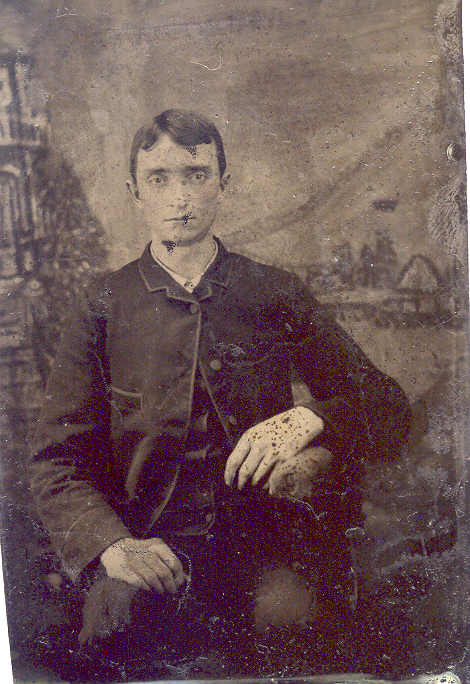
Tintype Men


A companion piece to my last post, "Tintype Women." The professional tintypist couldn't go down to the local camera store and buy materials. He had to buy sheet iron, either lacquer or paint the metal, make his photographic emulsions from basic chemicals, and often make his own camera. Because every photographer didn't have the same level of technical skill, tintypes often have ridges where the emulsion was unevenly applied. Variation in chemical mixing meant that some tintypes were more sensitive to light than others allowing for shorter exposures. Tintypes, like many other early photographic process were a one off. Without a separate negative, it was impossible to go into the lab and make additional prints. Some photographers built cameras with multiple lenses so that they could make multiple exposures at once. Note that the second image in the group is a copy made from another tintype. It's impossible to tell, but that may be a thumb holding the original when the exposure was made. Since tintypes are flopped, a tintype copy of another tintype would be right reading. The heavily damaged image not only shows a great deal of corrosion of the metal base and missing emulsion, but a loss of the underlying black coating that makes the tintype negative appear positive. As usual, click on tintype in the labels section for more info on the history of tintypes.

Tintype Women


I've written about the history and process of the tintype in previous posts and recommend that anyone wishing to know more, click on tintype in the labels section. I will repeat that tintype was a popular, though incorrect name. Tintypes are actually made of sheet iron. Note the rust on the one image. Tintypes are actually a negative made on either a black painted, or black lacquered piece of iron, which makes them appear as a positive. An inexpensive process, they became one of the earliest forms of photography for the masses. These are all from the nineteenth century.

Friday, November 5, 2010

Tintype With Mustache


I've put up a number of tintypes, and would suggest clicking on tintype in the labels section to pull up information on the history of the medium. This 19th century dandy has a great mustache, hair cut, cravat and bowler hat, and because he's so stylish, he gets a separate post.

Tuesday, August 31, 2010

Another Hand Painted Tintype


This is the second one of these I've found. (See my post 10/9/09.) Colored tintypes with eye color, or a rosey hue to the cheeks are quite common. Less common are tintypes that have had their entire surfaces painted in an attempt to make an image that looks more like a painting than a photograph. Usually those tintypes were painted over in a style that normally would be closer to the limner paintings of the colonial and early national eras than photographs. Like limner paintings, they were often made by itinerant artists who were just as comfortable decorating, furniture, clock faces, or making store signs. This image, and the one posted earlier, were done by a commercial service, and may have used more skilled painters than the travelling artists responsible for most painted tintypes. Of course this image, like the earlier one, has lost almost all of the surface paint, so we'll never know. My guess is, that what is left, is little more than a first inking that established specific areas to be painted. The admonition to not remove the glass from the picture may indicate that paint was also added to a covering glass, or it may indicate that the tintype was glued in some way to a sheet of glass.

Monday, August 30, 2010

A Tintype of Two Women


I've been meaning to put up another tintype gallery with five to ten images, but I found this one not too long ago, and even though it's not in great condition, I was really taken by the angry look of the standing woman, so it gets it's own, separate post. With the hair, the scowl, she looks almost feral. Too, the dress is so striking compared to dress of the sitting woman who has a much more serene demeanor. Mother and daughter or two friends? Anyway, as I've noted in earlier posts, tintype is actually a misnomer. Tintypes are actually ferrotypes, shot on a sheet of iron with either a black paint or lacquer coating which makes the negative image seem like a positive.

Thursday, July 8, 2010

A Tintype Head Shot


It's been my experience that tightly framed, head shot tintypes are fairly rare, though it's possible with the irregular boarders that this image may have been cut out from a larger area. As I've noted in other tintype posts, tintypes are actually negatives that appear positive against a black painted or lacquered iron base. Tintypes are actually called ferrotypes.

Thursday, April 8, 2010

Tintype Gallery


The process was first described in 1853 by French photographer and inventor, Adolphe-Alexander Martin, the tintype, more properly called the melainotype or ferrotype, was a photographic process where a direct positive print was made on a sheet of iron. Technically, the image is a negative, but exposed on a background that has been painted, lacquered, or enamelled in black, it appears to be positive. The ferrotype uses the same method as the ambrotype, except that the ambrotype was made on glass and then placed in a black, backed frame. The ferrotype also reverses the image, unless taken with a special camera with a built in prism, the image will be flopped. Because the materials were cheap, and almost indestructible, unlike the ambrotype, the tintype became the first affordable photographic process, making it possible for the lower middle and poor working classes to have portraits made. I've got lots, and lots of tintypes, this first five will, in time, be followed by other tintype galleries. I've already posted a couple of tintypes, unique in themselves. Click on tintypes in the label section.

Friday, October 9, 2009

A Strange, Hand Painted Tin Type


I try and report the things that are written, stamped, or printed on the backs of photos, but I rarely use up picture storage space to publish them to the blog. Tin types aren't all that uncommon, but finding one like this that has been hand painted is kind of rare.

Tuesday, September 29, 2009

Tin Type Before and After


This is from back when I was working at the photo lab. Every so often I could talk the digital department to do a little repair work on some of the old photos. The original is a 19th century tin type of an African American lady. After digital corrections, the generation of a black & white negative, I made this nice print.